
PHP Data Types
Easy PHP Data Types Guide: 4 Core Categories & Examples
Master backend memory management with this complete PHP data types guide. Learn scalar, compound, special types, type inspection, and strict typing.
Overview: Understanding PHP Data Types & Memory Classification
Quick PHP Data Types Summary:
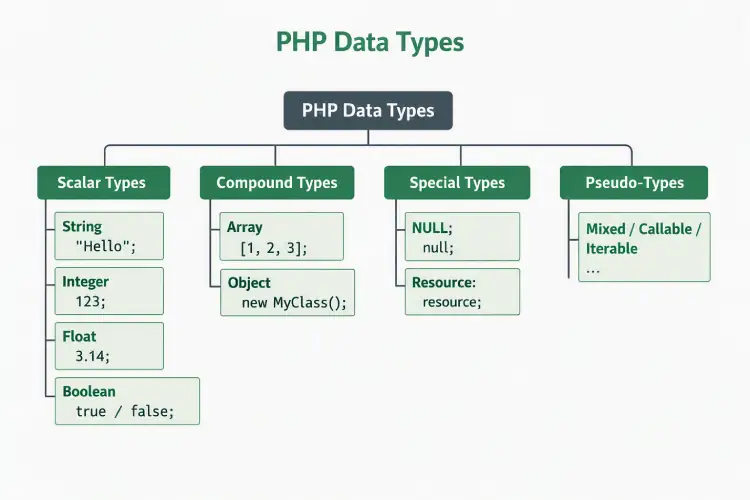
- 4 Core Categories: PHP divides data types into Scalar (single value), Compound (multiple values), Special, and Pseudo types.
- 8 Primary Data Types: Includes String, Integer, Float, Boolean, Array, Object, NULL, and Resource.
- Dynamic Type Assignment: PHP automatically determines variable data types at runtime based on assigned values.
- Type Inspection Tools: Built-in diagnostic functions like
var_dump()andgettype()allow developers to analyze variable structure in memory. - Strict Type Declarations: Modern PHP allows developers to enforce strict typing rules using
declare(strict_types=1);for better backend security.
Welcome to Lesson 6 of our structured web development course. Following our previous tutorial on Easy PHP Variables Guide: Complete Types & Scope Tutorial, you know how to create variables and manage global and local memory boundaries. The next critical step in backend software engineering is understanding how PHP classifies data in memory using PHP data types.
In programming, data types define the nature of values stored inside variables and dictate which operations (such as arithmetic, string concatenation, or array indexing) can be legally performed on those values.
In this comprehensive PHP data types tutorial, we will explore all four data type categories, type checking functions, explicit type casting, and modern strict typing standards.
Prerequisites Before Working with Data Types
To test the hands-on code examples in this PHP data types guide, ensure your environment meets these basic requirements:
- Active Development Server: A running installation of Apache or Nginx with PHP 8.x+ (via XAMPP, Homebrew, or Terminal).
- Code Editor: A modern code editor such as Visual Studio Code or PhpStorm.
- Variable Foundations: Familiarity with variable declaration syntax using the
$prefix.
If you need to review variable naming rules or memory scopes, visit our previous guide on Easy PHP Variables Guide: Complete Types & Scope Tutorial.
Category 1: Scalar Data Types (Single-Value Storage)
Scalar data types represent variables that hold a single individual value at any given moment. PHP supports four scalar data types:
1. String Data Type
A string is a sequence of characters enclosed within single quotes (' ') or double quotes (" "). Strings can hold plain text, HTML markup, or numeric sequences:
<?php
$greeting = "Hello, Web Developer!";
$filepath = 'C:\xampp\htdocs\index.php';

echo $greeting;
?>
2. Integer Data Type
An integer is a non-decimal number between -2,147,483,648 and +2,147,483,647 (on 32-bit systems) or up to 64-bit limits. Integers can be positive, negative, or zero:
<?php
$userAge = 28;
$temperature = -5;
$itemsInStock = 0;

// Integer addition
$nextYearAge = $userAge + 1;
?>
3. Float (Floating-Point / Double) Data Type
A float is a number containing a decimal point or a number written in exponential notation:
<?php
$productPrice = 19.99;
$scientificNotation = 1.2e3; // Equivalent to 1200
?>
4. Boolean Data Type
A boolean represents a truth value. It can strictly hold either TRUE or FALSE. Booleans are primarily used in conditional logic statements:
<?php
$isUserLoggedIn = true;
$hasAdminPrivileges = false;
?>
Category 2: Compound Data Types (Multi-Value Storage)
Compound data types allow variables to hold multiple values or complex data structures within a single variable name.
1. Array Data Type
An array is an ordered collection that stores multiple items under a single variable name. Arrays can hold indexed lists or key-value pairs (associative arrays):
<?php
// Indexed Array
$frameworks = ["Laravel", "Symfony", "CodeIgniter"];

// Associative Array (Key-Value Pairs)
$userProfile = [
    "username" => "alex_dev",
    "email" => "alex@example.com",
    "role" => "Administrator"
];

echo "Primary Framework: " . $frameworks[0] . "<br>";
echo "User Role: " . $userProfile['role'];
?>
2. Object Data Type
An object is an instance of a programmer-defined class that encapsulates both properties (variables) and methods (functions) inside a unified structure:
<?php
class Car {
    public $brand;
    public $model;

    public function __construct($brand, $model) {
        $this->brand = $brand;
        $this->model = $model;
    }

    public function getInfo() {
        return "Car: " . $this->brand . " " . $this->model;
    }
}

// Instantiating a new Car object
$myCar = new Car("Toyota", "Camry");
echo $myCar->getInfo();
?>
Category 3 & 4: Special Data Types & Pseudo-Types
1. NULL Data Type
NULL is a special data type that can have only one value: NULL. A variable assigned NULL represents an empty variable with no data allocated:
<?php
$sessionToken = null; // Variable explicitly initialized with no value
?>
2. Resource Data Type
A resource is not a true data type; it holds a reference to an external server resource—such as open database connections, file handles, or stream handles:
<?php
// Opening a local file creates a Resource variable
$fileHandle = fopen("example.txt", "r");
?>
Inspecting and Casting PHP Data Types
To verify or transform PHP data types during script execution, PHP provides built-in type inspection and explicit type casting methods.
Inspecting Types with var_dump() and gettype()
<?php
$score = 98.5;
$tags = ["php", "coding"];

// gettype returns a human-readable string
echo "Type of \$score: " . gettype($score) . "<br>";

// var_dump provides detailed type and length information
var_dump($tags);
?>
Explicit Type Casting
Type casting allows you to forcefully convert a variable from one data type to another:
<?php
$numericString = "125.75";

// Casting string to integer (truncates decimal)
$integerValue = (int)$numericString; // Result: 125

// Casting integer to boolean
$booleanValue = (bool)$integerValue; // Result: true
?>
Summary Comparison of All 8 Primary PHP Data Types
| Data Type Name | Category Classification | Example Value | Primary Use Case |
|---|---|---|---|
| String | Scalar | "Hello World" | Textual data, dynamic content rendering, HTML generation. |
| Integer | Scalar | 42, -100 | Counting, array indexes, iteration markers. |
| Float | Scalar | 19.99 | Financial calculations, scientific metrics, precise division. |
| Boolean | Scalar | true, false | Conditional logic, authentication flags, feature toggles. |
| Array | Compound | ["a", "b", "c"] | Storing structured records, lists, database query results. |
| Object | Compound | new User() | Object-Oriented Programming (OOP), encapsulation. |
| NULL | Special | null | Representing missing, empty, or uninitialized variables. |
| Resource | Special | fopen() handle | Managing external handles like database connections or files. |
Troubleshooting Common Data Type Errors
| Observed Error | Probable Cause | Recommended Solution |
|---|---|---|
TypeError: Unsupported operand types | Performing arithmetic operations on incompatible data types (e.g., adding an Array to an Integer). | Verify variable data types using var_dump() or explicitly cast string inputs to numeric types using (int) or (float). |
Warning: Array to string conversion | Attempting to display an Array variable directly using echo or print. | Use print_r() or a loop to output individual array elements. |
Error: Object of class ... could not be converted to string | Attempting to echo an Object variable directly without implementing a __toString() method. | Call specific object methods or properties (e.g., $obj->getProperty()) instead of echoing the raw object. |
Frequently Asked Questions (FAQ)
Q1: What are the primary PHP data types?
PHP features 8 primary PHP data types divided into 3 categories: Scalar types (String, Integer, Float, Boolean), Compound types (Array, Object), and Special types (NULL, Resource).
Q2: How does PHP handle dynamic data typing at runtime?
PHP is a loosely typed language. It automatically detects and converts variable data types dynamically depending on the value assigned to the variable or the operator applied to it.
Q3: What is the difference between gettype() and var_dump() in PHP?
gettype() returns a brief string name representing the variable’s current data type (e.g., “integer” or “string”). var_dump() provides detailed diagnostic output including data type, exact length, structure, and values.
Q4: What happens when you cast a float to an integer in PHP?
When casting a float to an integer (e.g., (int)19.99), PHP truncates the decimal portion completely, resulting in an integer value of 19 without rounding.
Next Steps & Official References
Consult official technical standards on the PHP Official Data Types Manual (php.net).
Ready for the next lesson in sequence? Proceed directly to the next lesson in Module 2: Next Lesson: PHP Strings & Built-in String Functions →
# Summary
Here is what you've learned in this lesson:
- Easy PHP Data Types Guide: 4 Core Categories & Examples
- Overview: Understanding PHP Data Types & Memory Classification
- Prerequisites Before Working with Data Types
- Category 1: Scalar Data Types (Single-Value Storage)
- Category 2: Compound Data Types (Multi-Value Storage)
- Category 3 & 4: Special Data Types & Pseudo-Types
- Inspecting and Casting PHP Data Types
- Summary Comparison of All 8 Primary PHP Data Types
- Troubleshooting Common Data Type Errors
- Frequently Asked Questions (FAQ)
- Next Steps & Official References
Continue to the next lesson and learn more about Understanding the “Incorrect Format Parameter” Error in phpMyAdmin.