
Table of Contents:
8 Powerful Ways to Master Traits in PHP OOP – Complete Guide
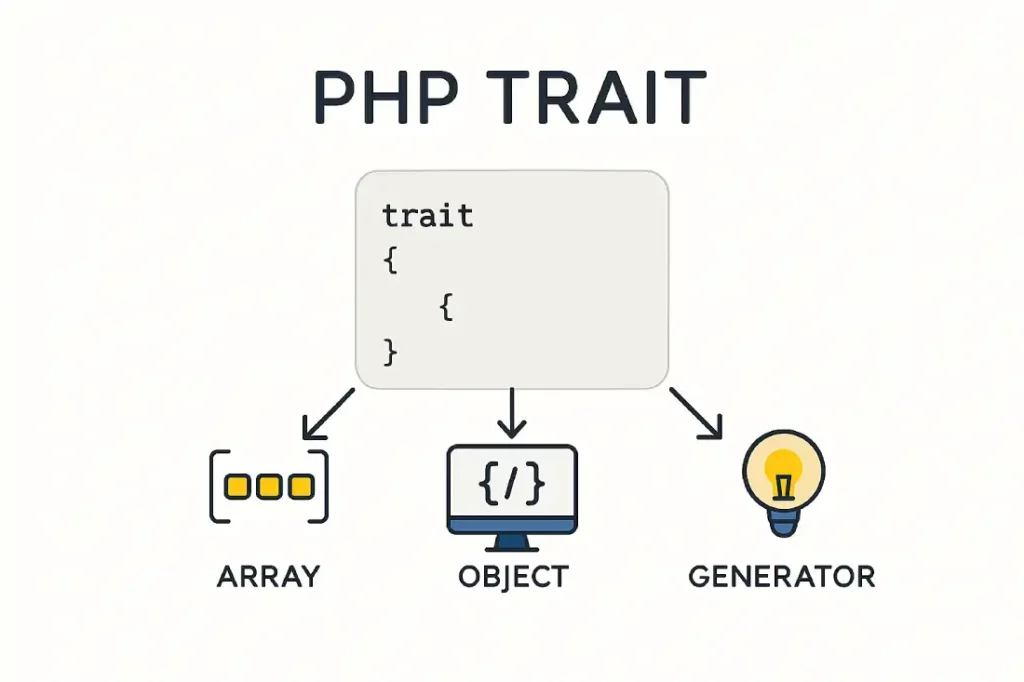
Traits are a powerful and positive feature in PHP Object-Oriented Programming that solve the problem of multiple inheritance in a clean and professional way.
This guide explains Traits in PHP OOP with simple examples, outputs, use cases, and best practices, making it easy to understand even for beginners.
What Are Traits in PHP Object Oriented Programming
Traits are a mechanism for code reuse in PHP. They allow you to include methods inside multiple classes without inheritance.
PHP does not support multiple inheritance directly, and traits solve this limitation efficiently.
Why Traits Are Powerful in PHP OOP Development
Traits help developers write cleaner, reusable, and maintainable code.
Key Advantages of Traits
- Enables multiple inheritance-like behavior
- Reduces code duplication
- Improves application scalability
- Keeps classes small and readable
- Encourages reusable design patterns
How to Declare and Use Traits in PHP
Basic Syntax of Trait in PHP
trait Message { public function showMessage() { echo "Welcome to PHP OOP Traits"; } } Using Trait Inside a Class
 class Website { use Message; }

$obj = new Website();
$obj->showMessage();
Output
Welcome to PHP OOP TraitsComplete Example of Traits in PHP with Output
Example: Reusing Code in Multiple Classes
trait Logger { public function log($msg) { echo "Log: " . $msg; } }

class User {
use Logger;
}

class Admin {
use Logger;
}

$user = new User();
$user->log("User logged in");

echo "<br>";

$admin = new Admin();
$admin->log("Admin logged in");
Output
Log: User logged in Log: Admin logged in Using Multiple Traits in a Single PHP Class
PHP allows using multiple traits in one class.
trait A { public function methodA() { echo "Method A"; } }
trait B {
public function methodB() {
echo "Method B";
}
}

class Test {
use A, B;
}

$obj = new Test();
$obj->methodA();
echo "<br>";
$obj->methodB();
Output
Method A Method B Resolving Method Conflicts in PHP Traits
When two traits have methods with the same name, PHP provides conflict resolution using insteadof.
trait First { public function show() { echo "First Trait"; } }
trait Second {
public function show() {
echo "Second Trait";
}
}

class Demo {
use First, Second {
First::show insteadof Second;
}
}

$obj = new Demo();
$obj->show();
Output
First Trait Difference Between Traits and Inheritance in PHP OOP
| Feature | Traits | Inheritance |
|---|---|---|
| Multiple Use | Yes | No |
| Code Reuse | Yes | Limited |
| Relationship | Horizontal | Vertical |
| Flexibility | High | Medium |
php traits, traits in php oop, php oop traits example, php multiple inheritance traits, php trait tutorial, php object oriented programming traits
Real World Use Cases of Traits in PHP
Traits are commonly used in professional PHP projects.
Practical Applications
- Logging functionality
- Authentication methods
- File upload helpers
- API response handlers
- Reusable validation logic
Best Practices for Using Traits in PHP OOP
Follow these rules to write professional PHP code:
- Keep traits small and focused
- Do not store business logic in traits
- Avoid overusing traits
- Use traits for reusable methods only
- Document trait usage clearly
Common Mistakes While Using Traits in PHP
Avoid These Beginner Errors
- Using traits as replacement for classes
- Adding properties without clear purpose
- Creating large traits with many responsibilities
- Ignoring method conflict handling
To strengthen your PHP OOP knowledge, read this guide:
Frequently Asked Questions About PHP Traits
Can traits have properties in PHP
Yes, traits can contain properties as well as methods.
Can traits use other traits
Yes, traits can use other traits inside them.
Are traits better than inheritance
Traits are not better, but they are more flexible for code reuse.
Can traits be overridden in classes
Yes, class methods can override trait methods.
Should beginners use traits
Yes, after understanding classes and inheritance basics.
Final Conclusion on Traits in PHP OOP
Traits are a powerful and positive solution to code reuse problems in PHP Object-Oriented Programming. They allow developers to write flexible, maintainable, and scalable applications.
By practicing these examples and outputs, you can confidently use Traits in real-world PHP projects and take your PHP OOP skills to the next level.