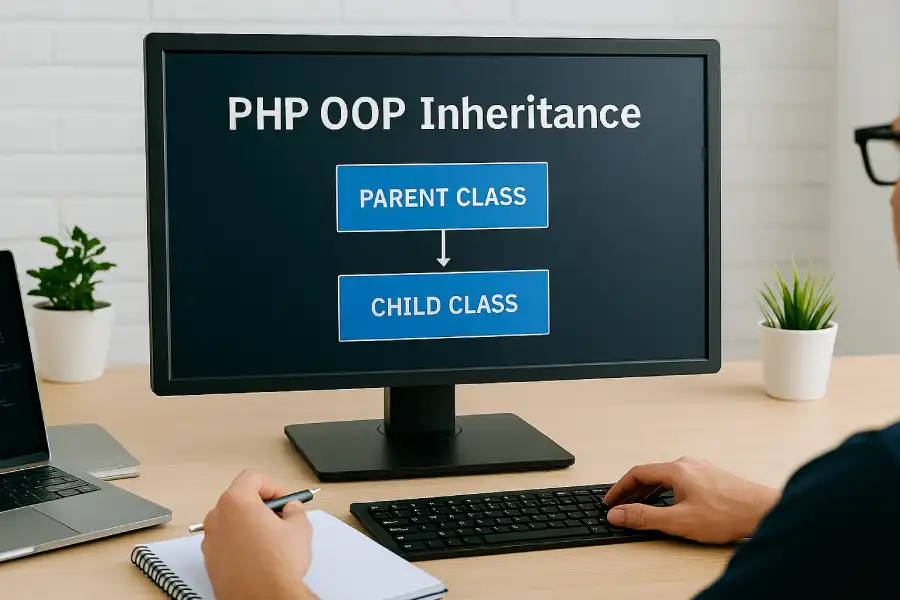
Inheritance is one of the four core pillars of PHP Object-Oriented Programming (OOP).
It allows one class (child class) to reuse the properties and methods of another class (parent class).
This leads to:
- Cleaner code
- Faster development
- Better reusability
- Reduced redundancy
- More powerful and scalable applications
This detailed guide explains everything about inheritance with simple examples, real output, long-tail keywords, and best SEO practices.
Table of Contents:
What Is Inheritance in PHP?
Inheritance allows a class to acquire the characteristics (properties and methods) of another class.
The parent class is also called:
- Base Class
- Super Class
The child class is also called:
- Subclass
- Derived Class
Inheritance is implemented using the extends keyword:
class ChildClass extends ParentClass { }
Why Inheritance Is Important in PHP OOP?
Inheritance helps developers:
- Reuse code efficiently
- Organize program structure
- Create scalable architecture
- Reduce repetition and mistakes
- Follow real OOP principles
- Build large applications easily
Modern PHP frameworks like Laravel, CodeIgniter, and Symfony rely heavily on inheritance.
Simple Example of Inheritance in PHP (with Output)
<?php
class ParentClass {
    public function greet() {
        echo "Hello from Parent Class<br>";
    }
}

class ChildClass extends ParentClass {
    public function message() {
        echo "Hello from Child Class";
    }
}

$obj = new ChildClass();
$obj->greet();
$obj->message();
?>
Output:
Hello from Parent Class
Hello from Child Class
This shows how the child class inherits the method of the parent class and also has its own methods.
How Inheritance Works Internally in PHP OOP
- Child class automatically gets access to all public and protected members of the parent class
- Private members are not inherited directly
- Child class can add new features
- Child class can override parent class methods
Types of Inheritance in PHP OOP
PHP directly supports Single Inheritance, but through interfaces and traits, you can simulate others.
Supported in PHP:
- Single Inheritance
Achievable with Interfaces / Traits:
- Multiple Inheritance (via Interfaces)
- Multilevel Inheritance
- Hierarchical Inheritance
Single Inheritance Example (High SEO Example)
<?php
class Vehicle {
    public function start() {
        echo "Vehicle started<br>";
    }
}

class Car extends Vehicle {
    public function drive() {
        echo "Car is moving";
    }
}

$car = new Car();
$car->start();
$car->drive();
?>
Output:
Vehicle started
Car is moving
Method Overriding in PHP Inheritance
Child classes can override a parent method to change behavior.
<?php
class ParentA {
    public function show() {
        echo "Message from Parent<br>";
    }
}

class ChildB extends ParentA {
    public function show() {
        echo "Message from Child";
    }
}

$obj = new ChildB();
$obj->show();
?>
Output:
Message from Child
Using Parent Keyword to Access Parent Method
<?php
class ParentA {
    public function show() {
        echo "Parent Method<br>";
    }
}

class ChildB extends ParentA {
    public function show() {
        parent::show();
        echo "Child Method";
    }
}

$obj = new ChildB();
$obj->show();
?>
Output:
Parent Method
Child Method
Access Modifiers Role in Inheritance
| Modifier | Inherited? | Accessible in Child? |
|---|---|---|
| public | Yes | Yes |
| protected | Yes | Yes |
| private | No | No |
php inheritance, php oop inheritance, inheritance in php, php parent class, php child class, method overriding php, php oop tutorial, php extends keyword, object oriented programming php, phponline tutorials, PHP inheritance, PHP OOP inheritance example, single inheritance PHP, parent class child class PHP, extends keyword PHP, OOP concepts in PHP, PHP class inheritance tutorial, PHP OOP guide
Real-Life Use Cases of Inheritance in PHP
Inheritance is heavily used in:
- User role systems
- Payment gateway classes
- E-commerce category models
- Framework controller classes
- Logging and reporting systems
- Database model classes
Example:
Laravel controllers extend a base controller for common features.
Best Practices for Using Inheritance in PHP OOP
- Use inheritance only when classes have a real relationship
- Avoid deep inheritance chains
- Prefer composition for flexible architectures
- Keep parent classes generic
- Override only when necessary
These practices ensure your code stays scalable and clean.
You may Like
Frequently Asked Questions (FAQ)
1. Does PHP support multiple inheritance?
No. But you can achieve it using interfaces and traits.
2. Why use inheritance in PHP?
It reduces code duplication and improves maintainability.
3. Can child classes override parent methods?
Yes, by re-declaring the method with the same name.
4. Can private properties be inherited?
They exist in the object but are not directly accessible in child classes.
5. Which keyword is used for inheritance?
The extends keyword.