
Table of Contents:
Classes and Objects – PHP OOPs
Modern PHP development heavily relies on Object-Oriented Programming (OOP). Understanding classes and objects is the foundation of writing clean, structured, and scalable PHP applications. Whether you’re building a CMS, API, or eCommerce platform, OOP concepts make PHP development faster, more efficient, and easier to maintain.
This complete guide explains PHP classes and objects with structured explanations, code examples, and long-tail keyword subheadings for higher SEO performance.
What Are Classes and Objects in PHP?
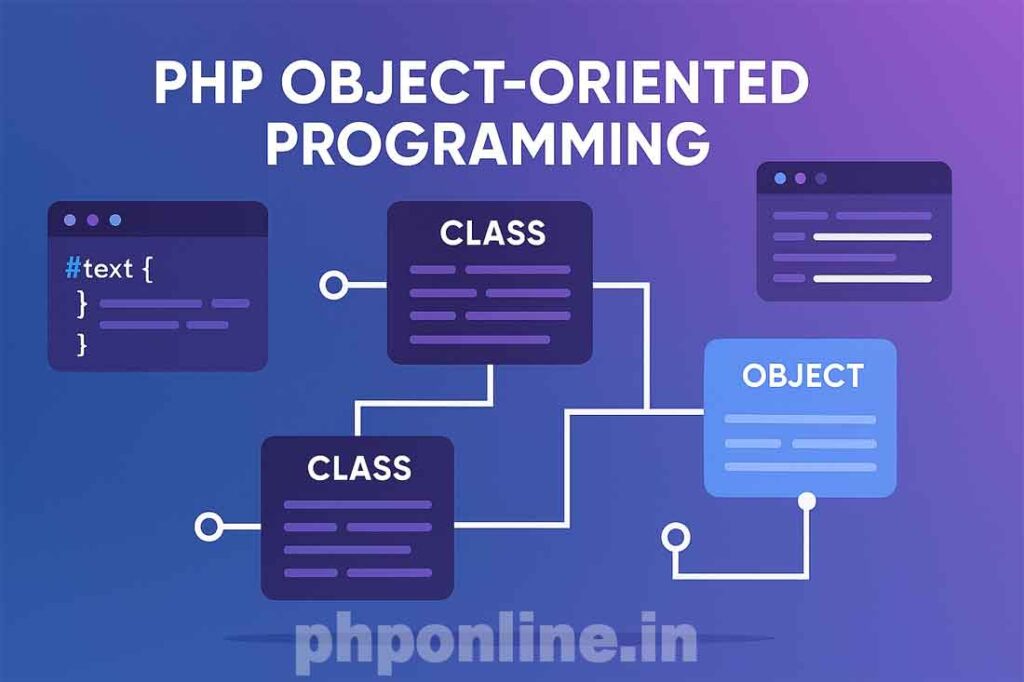
A class is a blueprint or template that defines the structure and behavior (properties and methods) of an object.
An object is an actual instance of a class created using the new keyword.
Example:
class Car {
    public $brand;
    public $color;

    public function start() {
        return "Car started";
    }
}

$myCar = new Car();
This example shows that $myCar is an object created from the Car class.
Why PHP Classes and Objects Are Important in Modern Development
Using OOP in PHP has several advantages:
- Better code organization
- Faster development
- Reusability of classes and methods
- Enables modular and scalable architecture
- Improved debugging and testing
- Allows implementation of design patterns
- Suitable for large, complex applications
OOP is essential for any PHP developer aiming to write professional-grade applications.
PHP classes, PHP objects, PHP OOP tutorial, object oriented programming in PHP, PHP OOP examples, how to create class in PHP, PHP methods, PHP constructors, PHP properties, PHP object basics
How to Create a Class in PHP (Beginner-Friendly Example)
A class is defined using the class keyword:
class Student {
    public $name;
    public $age;

    public function showInfo() {
        return "Name: $this->name, Age: $this->age";
    }
}
A class typically contains:
- Properties – variables inside a class
- Methods – functions inside a class
- $this keyword – refers to the current object
How to Create an Object in PHP OOP
To create an object, use the new keyword:
$student = new Student();
$student->name = "Rahul";
$student->age = 22;
echo $student->showInfo();
Output:Name: Rahul, Age: 22
Understanding Properties and Methods in PHP Classes
Properties
These are variables defined inside a class.
Methods
Functions inside a class that perform actions.
Example:
class Employee {
    public $id;
    private $salary;

    public function setSalary($amount) {
        $this->salary = $amount;
    }

    public function getSalary() {
        return $this->salary;
    }
}
This example also introduces visibility modifiers:
publicprivateprotected
PHP Constructors Explained with Real Examples
Constructors allow automatic execution when an object is created.
Example:
class Product {
    public function __construct() {
        echo "Product created!";
    }
}

$product = new Product();
This displays the message as soon as the object is created.
PHP Destructors with Simple Example
Destructors run automatically at the end of script execution:
class Test {
    public function __destruct() {
        echo "Object destroyed.";
    }
}
Accessing Class Methods and Properties in PHP
To access members of a class:
- Use
->outside the class - Use
$this->inside methods
Example:
$this->name;
$object->methodName();
Real-World Example of Classes and Objects in PHP
class BankAccount {
    private $balance = 0;

    public function deposit($amount) {
        $this->balance += $amount;
    }

    public function withdraw($amount) {
        if($amount <= $this->balance) {
            $this->balance -= $amount;
        } else {
            return "Insufficient balance";
        }
    }

    public function getBalance() {
        return $this->balance;
    }
}

$acc = new BankAccount();
$acc->deposit(1000);
echo $acc->getBalance();
This example demonstrates real-life use cases in banking and financial applications.
Best Practices for Writing PHP Classes and Objects
- Use meaningful, clear class names
- Keep each class focused on a single responsibility (SRP)
- Use visibility modifiers properly
- Initialize values using constructors
- Keep methods short and readable
- Avoid global variables
- Follow PSR-12 coding standards
- Use autoloading with Composer
You may like:
- Learn more about PHP OOP Concepts on our homepage: phponline.in
- Read: PHP Inheritance Tutorial
- Explore: PHP Functions Complete Guide
Frequently Asked Questions (FAQ)
1. What is a class in PHP?
A class is a blueprint that defines variables and functions for creating objects.
2. What is an object in PHP?
An object is an instance of a class that allows access to its properties and methods.
3. Why is OOP important in PHP?
OOP makes PHP code more reusable, manageable, modular, and scalable.
4. Can a PHP class have multiple constructors?
No, PHP does not support multiple constructors directly, but you can simulate them using optional parameters.
5. What is the purpose of the $this keyword?
$this refers to the current object inside a class method.